
Something Else is Required.
Outrage is a form of self-indulgence. It feels like action. It isn’t.

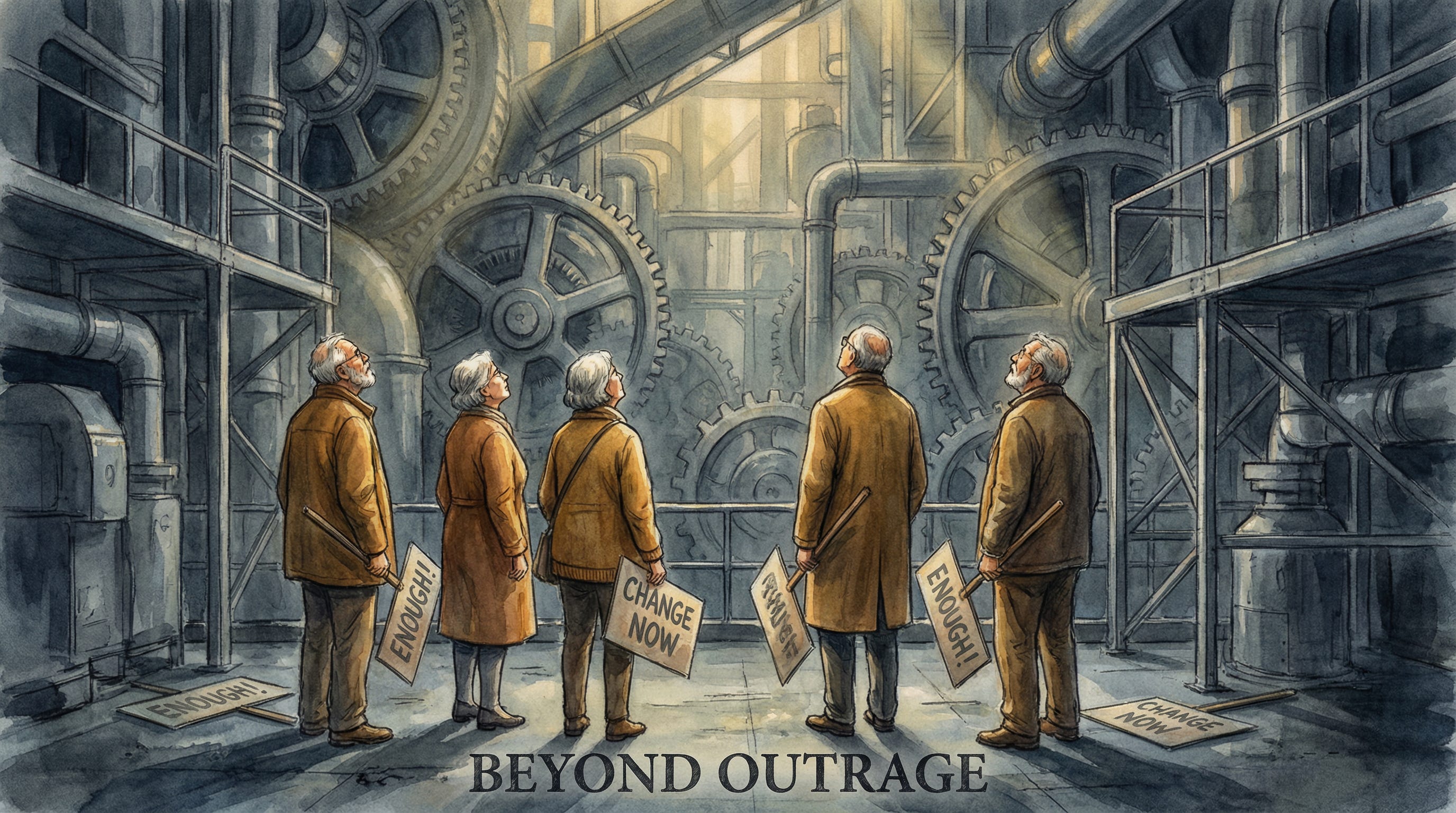
A civil rights attorney recently went viral on X with a proposal: stop calling them “Health Insurance Companies.” Call them “Health Exploitation Limited Liability Corporations.” HELL Corporations.
The comments filled with “HELL yes.” Thousands of shares. The dopamine hit of naming the villain.
I understand the impulse. Naming matters. Language shapes perception, and the perception of this industry deserves to be shaped by the truth of what it does. But I want to sit with an uncomfortable question: What happens after we name them?
Nothing. That’s what happens. The industry absorbs the insult the way it absorbs everything else — fines, lawsuits, congressional hearings, even an assassination — and continues operating. UnitedHealth Group collected $400 billion in revenue last year. Its stock dropped after its CEO was shot outside a Manhattan hotel, then stabilized, because markets don’t care about outrage. Markets care about structure. And the structure is intact.
Outrage is a form of self-indulgence. It feels like action. It isn’t.
The system we’re confronting — the trillion-dollar architecture that turns aging into a revenue event — was not built by people who were outraged. It was built by people who were patient, strategic, and relentless. They moved slowly. They fragmented the opposition. They commodified human beings in broad daylight and called it a business model.
If we respond only with outrage, we are fighting on their terms — reacting to a machine that was designed to absorb reaction, pay the fine, weather the headline, and keep operating.
Consider the scale of what patience built:
Private equity firms completed over 1,000 healthcare deals in 2025 alone. They now own nearly 500 U.S. hospitals and control hundreds of nursing home chains. A National Bureau of Economic Research study found that PE ownership of nursing homes caused an estimated 20,150 excess deaths over twelve years — roughly 1,000 elders per year, killed not by disease but by disinvestment.
The six largest health insurers collected $1.48 trillion in combined revenue in 2024. Their CEOs earned between $15 million and $26 million each. The industry spent $744 million on lobbying that same year — more than any other industry in America — and contributed $384 million in campaign money. Two-thirds of Congress received pharmaceutical industry donations in 2020.
In Medicare Advantage alone, insurers made 52.8 million prior authorization decisions in 2024 and denied 4.1 million. Of those denials that were appealed, 80.7% were overturned — meaning most were unjustified. But only 11.5% of patients ever appeal. The system doesn’t need to win on the merits. It just needs you to give up.
This was not built by outrage. It was built by lobbyists who rotate between writing the rules and profiting from them. By private equity firms that load nursing homes with debt, extract cash through shell companies, and exit before the collapse. By an industry that treats federal fines as a line item against $170 billion in annual revenue.
Clever tweets do not threaten this architecture. Viral posts do not restructure ownership. Renaming the enemy does not build the power required to dismantle what the enemy built.
Something else is required.
I don’t say that glibly, and I don’t say it with a ten-point plan in hand. I say it as someone who has spent years inside this system — as a chaplain in a retirement home, as a caregiver, as a researcher, and now as an organizer — and who has learned that the distance between understanding the problem and building the response is measured in years, not posts.
But I can say what the work looks like, even if the full blueprint is still being built.
The work is local. Not viral — local. It happens in rooms where people know each other’s names. Where an elder who was denied dialysis because a doctor assumed she was “too old” can tell that story to people who will do something about it. Where a disabled veteran pressured toward “comfort care” because his doctors couldn’t imagine his life as worth living gets to say, in a room full of witnesses: My life matters. My voice matters. I get to decide.
The work is relational. It is built on trust accumulated over months and years, not on follower counts. It requires showing up when there is no audience. It requires accountability — not the performance of accountability, but the actual practice of committing to specific actions, reporting back, being honest about failure, and trying again.
The work is structured. There is a methodology — time-tested, forged in communities that could not rely on institutions to save them — that moves from seeing reality clearly, to judging it through a moral framework, to acting collectively. See. Judge. Act. It is not glamorous. It is not fast. It is how ordinary people, gathering in living rooms and church basements, have changed systems that seemed permanent.
And the work is underway.
We have published a dossier — Who Profits From Your Pain — that names the private equity firms, the insurance giants, the lobbying apparatus, and the revolving door that sustains all of it. We have mapped the nine structural forces that perpetuate the elder care crisis. We have documented the captive strategy by which aging Americans are funneled into systems designed to extract from them.
That was the indictment. What comes next is the strategy — not a manifesto written from the sidelines, but an organizing framework built from the ground, in community, with the elders and caregivers who live inside this system every day.
I understand why “HELL Corporations” felt good. Naming evil always does. But the people who built this machine were not named into power. They organized into it. They wrote legislation. They funded campaigns. They placed their people inside the agencies meant to regulate them. They built, brick by brick, over decades.
If we are serious — and I believe many of us are — then we must build with equal patience, equal strategy, and greater moral clarity. Not because outrage is wrong. But because outrage alone is not enough. It never was.
The elders dying in understaffed nursing homes tonight do not need us to rename the system. They need us to replace it.
That work has begun.
Patient organizing is never as appealing as raising a fist or shouting an insult. But you are right on point. That's the only way to make lasting change.