

[This is an introduction to a series of articles outlining the issues and potential remedies for the crisis of caregiving for families and professionals in the United States, in particular. ]
What follows is a story that is occurring all too often in this country.
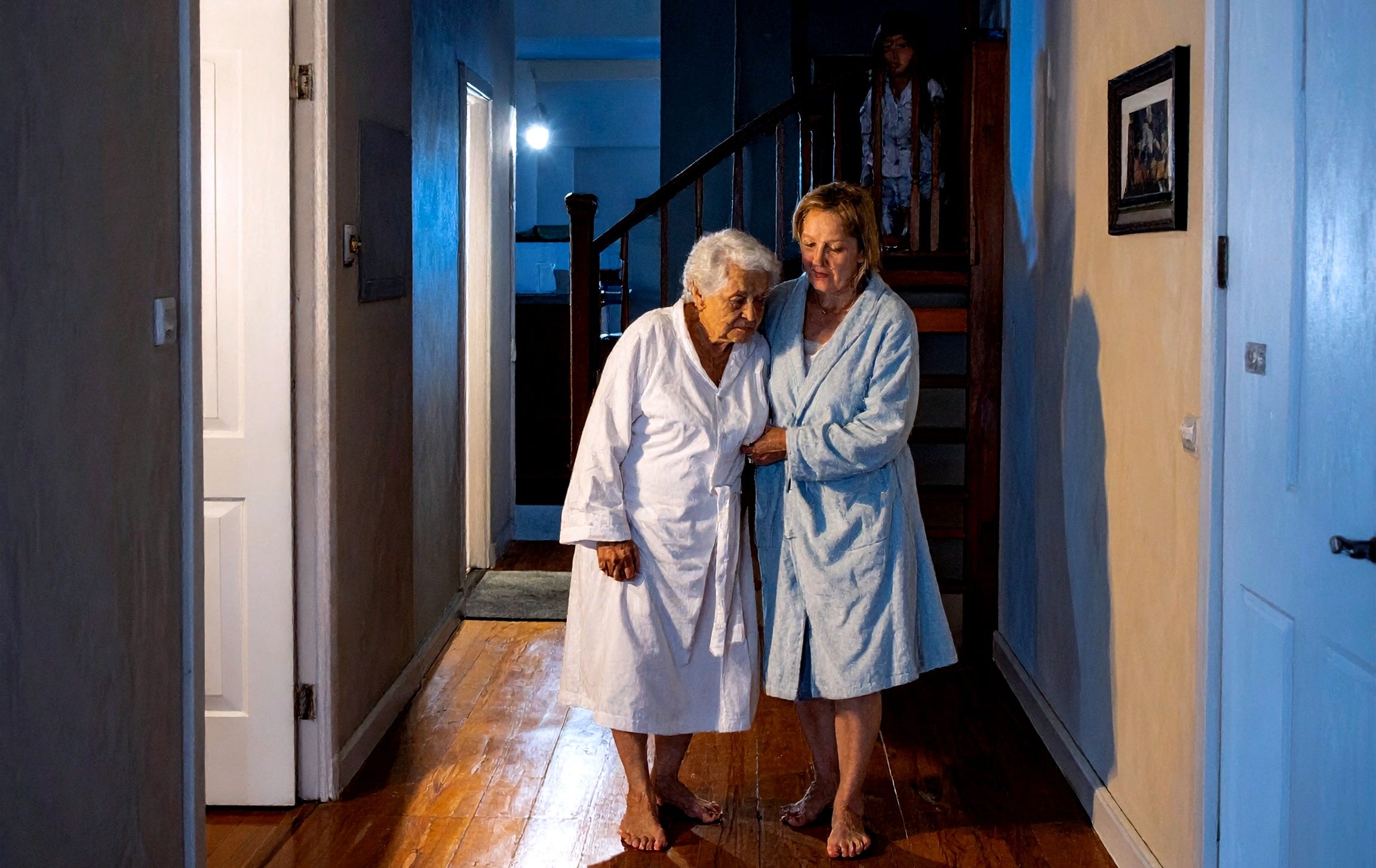
It starts at 2:17 in the morning.
The baby monitor crackles first, a soft burst of static from the in‑law suite over the garage. Then the door alarm chimes from downstairs—three sharp beeps that slice through sleep and adrenaline.
“Hello? Is anyone there?”
Dorothy’s voice is high and panicked.
Sylvia is out of bed before she’s fully awake. Her feet find the familiar path across the bedroom floor. In the hallway she’s already pulling on her robe, heart pounding, listening for the second sound she dreads and expects: her twelve‑year‑old daughter’s door opening.
“Mom, what’s going on?”
Not yet, she thinks. Please, not this time.
By the time Sylvia reaches the kitchen, Dorothy is standing in front of the open pantry in her nightgown, barefoot on the cold tile, hands moving aimlessly over cereal boxes and cans of soup.
“Mom. It’s the middle of the night. Let’s get you back to bed.”
“I need to find your father.” Dorothy doesn’t look at her. “He’s supposed to pick me up. Where is he?”
“Mom, Dad died ten years ago.”
Dorothy turns. Her eyes sharpen. “Don’t lie to me. You’re keeping him from me. Why would you do that? What kind of daughter—”
“I’m not keeping him from you,” Sylvia says, quietly, like she’s said it a hundred times. “He died. In 2013. It’s 2025.”
The words land like a physical blow. For a second, Dorothy’s face crumples around a grief that never fully arrives, because it never fully stays. The realization that something catastrophic has happened passes through her like lightning—and then is gone.
“Where’s my coat? I need to go.” She moves toward the front door.
“You can’t go out,” Sylvia says, stepping in front of her. “It’s 2 AM. You’re confused.”
“I’m not confused. You’re confusing me. On purpose.” Dorothy tries to push past her. “Let me by.”
“I can’t.”
“You can’t? Or you won’t?”
“Mom, what’s going on?”
Sylvia turns. Christine is at the top of the stairs in pajamas, hair messy, scowling in the way of twelve‑year‑olds who have been woken too many times.
Then she sees her grandmother in the hallway, in her nightgown, wild‑eyed. She sees her mother’s body blocking the doorway. She sees the fear on both their faces.
The annoyance drains away. What’s left is something between concern and fear.
“Grandma?”
“Do you know where Gus is, young lady?” Dorothy asks.
Christine freezes.
Gus was Sylvia’s father. Dorothy’s husband. He’s been dead for a decade. Christine has heard his stories her whole life. Gus, who taught Sylvia to drive in the church parking lot. Gus, who made pancakes in funny shapes.
Her grandmother’s voice is sharp. But what makes Christine’s stomach drop is the blankness.
Dorothy doesn’t know who she is.
Christine looks at her mother. She looks back at her grandmother. In that moment, she understands that things are worse than she thought.
“Mom,” Sylvia says quietly, not looking away from Dorothy, “let’s get you back to bed.”
“Can I… is there anything I can do?” Christine asks.
“Yes,” Sylvia says. “You can help me get Grandma back to bed. Gently. It’ll be okay.”
But they’re not okay, and Christine knows it. She walks down the stairs anyway.
They guide Dorothy back to the in‑law suite together. Dorothy’s fight drains away as quickly as it flared. By the time they reach the bed she’s distant again, somewhere else entirely.
“You lied to me,” Dorothy says quietly as Sylvia pulls the covers up.
“I didn’t lie, Mom.”
“You did. You’re lying right now. I can tell.”
Sylvia swallows. “Christine, can you check the nanny cam?”
Her daughter nods, grateful for something concrete to do. “Still recording.”
“Baby monitor?”
“On.”
“Thanks, sweetheart. I’ve got it from here.”
Christine pads back upstairs. Sylvia sits on the edge of the bed, takes her mother’s hand, and begins to hum the lullaby Dorothy used to sing to her. The tune feels like muscle memory from another life.
Dorothy’s breathing slows. Her face softens. Sleep, when it comes, is both mercy and theft.
“I miss you, Mom,” Sylvia whispers. “I miss you.”
She resets the door alarm, tiptoes out, and closes the in‑law suite door behind her.
It’s 3:15 AM.
Christine is sitting halfway down the stairs, knees tucked into her chest. When Sylvia reaches her, the composure she’s held together by threads snaps.
She crumples into her daughter’s arms and sobs.
Christine holds her without saying anything. Sylvia feels, with a flash of shame, how small her daughter’s arms are around her, how light her hands on her back. Too small for this.
After a few minutes, Sylvia forces herself upright.
“Let’s try to get some sleep,” she says.
Back in her own bed, staring at the framed black‑and‑white photo of her parents on the wall—Dorothy smiling in a dress she no longer recognizes, Gus with his arm around her—Sylvia whispers again.
“I miss you.”
Sleep does not come.
The morning after
The alarm goes off at 5:30 AM.
It might as well be the same night. The room has not changed. Dorothy is still asleep in the in‑law suite. Christine is in her room down the hall. Sylvia is more tired than she thought it was possible to be and still move.
She has to be at the law firm by 8:15.
At 7:00, she is pulling on slacks and a blouse when her husband appears in the doorway.
“What happened last night?”
She hears it in his voice—not concern, not exactly. Exhaustion. The weariness of a man who is watching his wife disappear and doesn’t know how to stop it.
“Mom had an episode,” she says. “She tried to leave the house around 2 AM.”
He stands there in his work clothes, ready for a day that will be uninterrupted. It hits her that he’s slept through both the alarm and the crying.
“Did you get any sleep?” he asks finally.
“Some.”
“Sylvia, this can’t keep happening.”
“I know.”
There’s a sentence he doesn’t speak. She hears it anyway: You can’t keep doing this and stay married to me and parent our daughter and keep your job and not fall apart.
He walks away before he finishes it out loud.
In the bathroom, steam fogs the mirror while Sylvia thumbs out a text with one hand.
Mom had an episode around 2 AM. Tried to leave the house. She’s settled now, but keep a close watch when you get here.
She sets the phone on the counter and steps into the shower. By the time she’s rinsed the shampoo from her hair, Carol has replied.
Jesus. Okay. I’ll be there by 8.
The water is scalding. It still doesn’t wash the night off.
Pretending to function
By 8:15 AM, Sylvia is at her desk at the law firm.
She has been awake for nearly seven hours. She has had one cup of coffee and half a piece of toast pulled apart in exhausted fingers.
Her boss is in his office prepping for client meetings. On one screen, Sylvia has his calendar open. On the other, her email. The tasks are ordinary: draft correspondence, format a contract, confirm travel for next week’s depositions.
Her hands move across the keyboard. Her eyes track dates and names.
Her mind is still in the kitchen at 2:17 AM.
Did Carol arrive on time? Did she reset the alarm? What if Mom tries to leave again?
At 10:00 AM, her boss calls her in.
“Sylvia, I need you to reschedule the Henderson client meeting. His flight was canceled. Can you coordinate with the other two offices to find a time that works for everyone this week? I need it done by the end of the day.”
She nods. She takes notes. She does not say, I’ve been awake since 2 AM. My mother is in crisis. I can barely remember my own password.
“I’ll get on it right now,” she says.
She returns to her desk and opens three calendars side by side. The numbers blur. She rereads each email twice. She loses track of which office is on which time zone.
Her hands shake slightly when she picks up the phone.
At 12:30, her cell rings. Carol.
“I’m so sorry,” Carol says. “I had to take Mom to the store with me. I couldn’t leave her alone that long. We were only gone twenty minutes. When we got back, she got confused and tried to go back out through the front door. Before I could get her settled. Linda saw her and helped me get her back inside.”
Sylvia’s heart is pounding.
“Is she okay?”
“She’s fine. She’s settled now. But Sylvia, I don’t think I can take her out anymore. It’s too risky. And I can’t leave her alone, even for a few minutes.”
“I know,” Sylvia says. “I’ll come home.”
“You don’t have to—”
“I’m coming home.”
She hangs up. She does not walk down the hall to ask permission. She sends a single sentence by email.
Family emergency. Need to leave. Will make up time tomorrow.
She grabs her bag and leaves, feeling the thin thread that ties her to her job fray just a little more.
A family meeting with no answers
That night, Dorothy is finally asleep.
The baby monitor glows on the coffee table. Sylvia, her husband, her sister Carol, Carol’s husband Tom, and Christine sit in the living room.
“We can’t keep doing this,” Sylvia says. “Last night, Mom tried to leave at 2 AM. Today, she tried to leave when Carol took her to the store. The alarms help, but they’re not enough. We have to figure out what to do.”
“I think we need to consider a facility,” Carol says. “I can’t leave my own kids every day anymore.”
“No.” Sylvia’s husband shakes his head. “We’re not putting her in a nursing home. Have you seen those places? Understaffed, medications mixed up. I’m not doing that to Dorothy.”
“Then what do you suggest?” Carol asks. “Hire someone? In‑home care?”
“Tom and I looked into it,” she continues. “It’s twenty‑five dollars an hour. For full‑time coverage, that’s four thousand a week. We don’t have that.”
“Maybe we could do part‑time,” Tom tries. “Someone to cover nights, so Sylvia can sleep.”
“That’s still a thousand a week,” Sylvia says quietly. “We don’t have it.”
Her husband shifts in his chair.
“What about reducing your hours at work? If you were home more—”
“With what for money?” Sylvia snaps before she can soften it. “My paycheck covers the mortgage gap. No paycheck, no house.”
“We could sell and move somewhere smaller,” he says.
“And uproot Christine in the middle of middle school?” Sylvia asks. “To where? Somewhere even more cramped, where Mom is more trapped?”
Christine has been perched on the arm of the couch, trying not to be noticed. She is twelve and already learning how to make herself small.
“What about Grandma?” she says suddenly. “Does anybody care what she wants?”
Everyone turns to look at her.
“She doesn’t know what she wants, sweetheart,” Carol says gently. “That’s the problem.”
“Then maybe we’re asking the wrong question,” Christine says, her voice thin but steady. “Maybe we should ask what we can’t keep doing instead of what we can do.”
Sylvia looks at her daughter. The same child who sat on the stairs at 3:15 AM holding her while she sobbed.
“What do you mean?” Carol asks.
“We can’t afford a home,” Christine says, counting on her fingers. “We can’t afford to quit. We can’t afford to hire someone. We can’t put Grandma in a home.” She looks up. “So what can we actually do?”
Silence falls over the room like a heavy blanket.
“We keep doing what we’re doing,” Sylvia finally says. “Until we can’t anymore.”
“And then what?” Carol asks.
“I don’t know,” Sylvia says.
Christine looks down at her hands. She has asked the question that matters: What happens when we can’t anymore? No one has an answer.
The meeting ends without a plan. Because there is no plan the system will fund.
The hidden option
The night after the family meeting, Sylvia sits alone at the kitchen table.
The house is quiet. Her husband is in the other room, reading or pretending to. Dorothy is sleeping fitfully in the in‑law suite. The baby monitor hums.
Sylvia opens her laptop. The search bar waits.
how to pay for nursing home care when you can’t afford it
The results are a wall of text. Elder‑law attorneys. Government portals. PDFs in small fonts. She clicks anyway.
One word appears over and over.
Medicaid.
She learns that Medicare—the insurance Dorothy paid into her whole working life—will cover hospital stays and some rehab but will not pay for long‑term nursing home care once it is “custodial.” When Dorothy needs help eating, toileting, bathing—what Sylvia already does—Medicare stops.
But Medicaid might pay.
There are conditions.
Income. Dorothy’s Social Security check is modest; that part looks okay.
Then: assets.
To qualify for Medicaid, Dorothy must have no more than two thousand dollars in countable assets.
Sylvia blinks. Reads the sentence again.
Dorothy has forty‑seven thousand dollars in savings and small investments. Nothing lavish. Money she and Gus scraped together over fifty‑two years by skipping vacations, driving the car a few years longer, clipping coupons.
To get help with nursing home care, Sylvia’s mother must first become poor.
She stares at the number: $2,000.
Later, she will learn about the “look‑back period”—how Medicaid can punish families if an elder gave away money in the previous five years. She will learn about “spend‑down”—how the money can be used on very specific things: nursing home bills, home modifications, funeral plans, medical debt. How it all must be documented, approved, justified.
Tonight, she only understands the shape of the trap.
The next morning she calls Carol.
“Did you know about the Medicaid thing?” Sylvia asks.
“What Medicaid thing?”
“Mom has to spend down to two thousand dollars in assets to qualify for nursing home coverage.”
Silence on the other end of the line.
“So we’d have to… what? Give the money away?” Carol says.
“Spend it,” Sylvia says. “Or strategically spend it in ways that don’t trigger penalties.”
“What do you mean, penalties?”
Sylvia tries to explain what she barely understands—five‑year look‑back, disallowed gifts, months of ineligibility. She hears herself using phrases like “resource limit” and “countable assets” and wants to scream.
“So basically,” Carol says slowly, “we’d have to help Mom become poor enough to qualify for assistance.”
“Yes.”
“That’s insane.”
“Yes.”
They sit in silence.
“How much would the nursing home cost if Medicaid covered it?” Carol finally asks.
“After Medicaid pays, Mom would contribute her Social Security—about $1,800 a month. Medicaid covers the rest. She’d get maybe fifty dollars a month for personal needs. That’s it.”
“And the forty‑seven thousand?” Carol says.
“It goes,” Sylvia says. “Nursing home, state, healthcare system. Not to us. Not to Mom.”
No inheritance. No cushion for when Sylvia or Carol are old. Just a transfer of her parents’ life savings into an underfunded, understaffed facility.
That night, Sylvia sits at the kitchen table again, laptop open to an elder‑law attorney’s website. She could become Dorothy’s conservator. She could hire the lawyer, go to court, take legal control of her mother’s finances, and spend down the money “strategically.”
The fee for the lawyer comes out of the same pot she is supposed to protect.
Even if she does all of it—court, paperwork, months of waiting—what does she get?
Her mother gets a bed in a crowded nursing home where aides sprint between too many residents. Sylvia gets some sleep.
She also gets to live with the knowledge that she methodically emptied her parents’ savings to make her mother poor enough for the state to help her.
It feels like betrayal, even if it’s legal.
She closes the laptop without making the call.
Instead, she walks down the hall to the in‑law suite. Dorothy is asleep on her side, breathing shallowly, face soft in the glow from the nightlight.
“I’m sorry, Mom,” Sylvia whispers from the doorway. “I’m sorry for all of this.”
She doesn’t mean she’s sorry for not doing enough. She means she’s sorry the entire system is built like this: that it asks her to choose between her own survival and her mother’s dignity, that it makes poverty the price of help, that it calls this “policy.”
The system that weaponizes love
A few days later, Sylvia’s pastor calls.
He’s heard Dorothy is getting worse. He wants to visit.
He sits on Sylvia’s couch on a Thursday evening when she is so tired she feels hollow. He is kind. He has known Sylvia since she was a teenager. He speaks with the practiced authority of a man who has spent thirty years explaining God to people.
“You’re doing such holy work,” he says. “Caregiving is a spiritual practice. Your mother is blessed to have a daughter like you.”
Sylvia says nothing.
“Your mother gave you life and raised you,” he continues. “Now you’re giving back. This is the fulfillment of the commandment to honor your father and mother. Honor thy father and mother, that thy days may be long upon the land. That’s a promise, Sylvia. God honors those who honor their parents.”
He leans forward.
“Your sacrifice is not unnoticed by God. God is using your caregiving to grow you in compassion and love. Your suffering has meaning. It’s redemptive. It’s making you holy.”
He leaves her with a prayer and a glossy pamphlet titled Finding Joy in Difficult Seasons.
The next day, Dorothy’s oldest friend calls to check in.
“You’re so blessed to have this time with your mother,” she says. “Not everyone gets that gift. My mother was in a home for the last three years of her life, and I’ve regretted it every day since.”
“Your mother didn’t have dementia,” Sylvia says, before she can stop herself.
“Well, no,” the friend says. “But that doesn’t change the fact that she was alone. You’re giving your mother something precious—family. Presence. Love.”
After she hangs up, Sylvia realizes what sits underneath both conversations.
You should be grateful. Your suffering is a privilege.
What she hears, beneath the well‑meaning words, is a theology that says:
Your exhaustion is spiritual growth.
Your sacrifice is redemptive.
Suffering purifies you.
Love demands this of you.
Resist, and you are selfish.
Complain, and you are ungrateful.
Question, and you are faithless.
If she says, No, I don’t want to be holy through my mother’s decline, she hears herself saying, No, I don’t love my mother.
The system hides behind that confusion. It makes it impossible to say no without feeling like a bad daughter, a bad Christian, a bad person.
It uses love to demand destruction.
It uses obligation to require sacrifice.
It uses God to silence protest.
The math no one admits out loud
Let’s pause Sylvia’s story for a moment and look at what she is actually doing.
Not as a daughter.
As a worker.
She is on call twenty‑four hours a day. When Dorothy wakes at 2 AM in a panic, Sylvia’s body responds before her mind is fully awake. There is no clocking out. No shift change.
She helps Dorothy toilet, bathe, and dress. She cleans up incontinence. She manages medications—what pills, what times, with which food. As Dorothy’s dementia progresses, each of these tasks takes longer and requires more vigilance.
She coordinates all medical care: appointments, specialist referrals, refills, insurance pre‑authorizations. She communicates with doctors who may or may not remember Dorothy from one visit to the next. She advocates in emergency rooms. She translates medical language into something her family can understand.
She provides emotional support and presence. When Dorothy is frightened, Sylvia sits and holds her hand until her breathing slows. There is no billing code for that.
She runs the household—cooking, cleaning, laundry—adapted around dementia. No throw rugs. No loose cords. Food cut into small pieces. Locks on doors. Alarms on windows.
On paper, Sylvia is not working more than full‑time. She is “just” a daughter.
In reality, if she stopped, the state would start paying.
If Dorothy were in a nursing home paid for by Medicaid, her care would cost tens of thousands of dollars a year.
Instead, the system quietly lets Sylvia do it all for free.
Sylvia loses income as she leaves work early, misses days, and turns down overtime. Over years, those lost hours become lost promotions, lost retirement contributions, lost Social Security credits. Many women caregivers lose hundreds of thousands of dollars in lifetime earnings over the course of a parent’s decline.
The state saves the cost of institutional care.
Hospitals and rehab centers discharge patients “home” sooner because there is a Sylvia waiting there.
Employers avoid offering robust caregiver leave because caregiving is “family business,” not work.
The math is simple and brutal: the system extracts enormous economic value from Sylvia’s labor and pays her nothing. When she collapses under the weight of it, it asks her if she has tried better self‑care.
An entire class of people in the shadows
It would be one thing if Sylvia’s story were an exception—a tragic personal situation, a sad outlier.
It isn’t.
In the United States, tens of millions of people—roughly one in eight adults—are doing some version of what Sylvia is doing: providing unpaid care to aging parents, disabled spouses, chronically ill partners, grandchildren.Caregiver-Liberation-Complete-Series.docx
They are losing sleep, losing income, losing health, losing pieces of themselves.
Most do it out of love.
All do it inside a structure that depends on their love and gives almost nothing back.
When Sylvia sits on the stairs at 3:15 AM, crying in her daughter’s arms, she feels alone. But she is not an isolated case of “poor work‑life balance.”
She is part of a structurally exploited class of caregivers whose labor keeps the entire long‑term care system from collapsing.
The system calls what she does “family duty.” It calls her suffering “holy.” It tells her that asking for pay or rest would cheapen the love.
It is lying.
What is happening to Sylvia is not a private tragedy or a failure of planning. It is the predictable outcome of policy choices that decided long‑term care would not be treated as a collective responsibility.
Her story is not the end of the conversation. It is the beginning.
Because once you see the forced choice Sylvia faces—to keep sacrificing herself at home, to institutionalize her mother, or to impoverish her to qualify for help—it becomes very hard to pretend this is about individual virtue anymore.
It becomes clear that the problem is not in Sylvia’s heart.
The problem is in a system that has quietly decided some people must disappear inside their homes so that everyone else can pretend care is free.
If you are holding someone at 2:17 AM, if you are choosing between your job and your parent, if you are googling “how to pay for nursing home care when you can’t afford it” with tears on your keyboard—you are not alone.
You are not failing.
You are being asked to carry more than any one person should have to carry.
The question is not how you can be better at it.
The question is how long we will let an entire system balance its books on your love.
Thanks for reading Toward Caregiver Liberatioin! Subscribe for free to receive new posts and support my work.