
Two Bankruptcies
On No Country for Old People, my grandmother at Wesley Homes, and what happens when dementia falls onto Medicaid.

Article 2 of 12
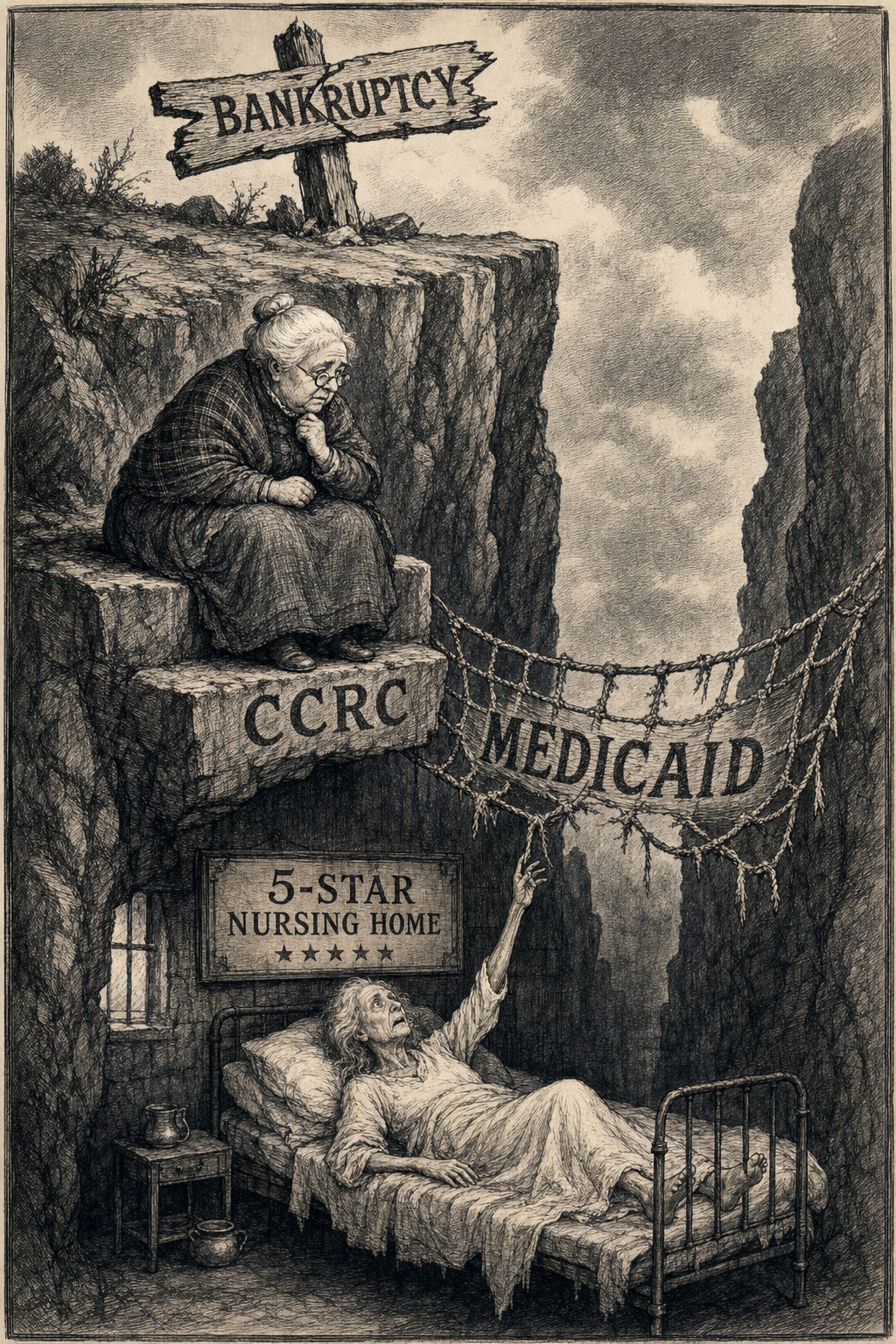
My grandmother and Norma Pecora both crossed the same line: private funds ran out, Medicaid took over, and the rest of their lives depended on what kind of place was waiting on the other side.
For my grandmother, that meant Wesley Homes, a life-care community that could absorb the spend-down without erasing place, ritual, or dignity. For Norma, it meant a five-star nonprofit nursing home that became a nightmare of bedsores, dehydration, sepsis, repeated hospitalizations, and a daughter fighting every day to keep neglect from hardening into death.
Two women with dementia, two bankruptcies, two Medicaid landings. One fell into care. The other fell into a hellscape that financed custody more reliably than care. That is the contrast this essay seeks to hold. Not one good family and one bad one. Not one woman who planned better and another who did not.
The five-star room
Norma Pecora lived with Alzheimer’s for sixteen years. She had been a child prodigy with a serious voice, someone who could have gone on the road but chose not to. She became an artist and an art dealer instead, a woman who spent her life among beautiful things. In the film, her daughter, Susie Singer Carter, describes the long attrition of that life: eleven years across four facilities, one move after another, until the money was gone and Medicaid narrowed the world to whatever bed would take her.
What Susie found looked safe. The nursing home had five stars. It was nonprofit. It was well-respected. It had the kind of institutional history that is supposed to calm a daughter down. The government rating said excellence. The reputation said excellence. The building said excellence. The lobby said excellence.
Then the room began to speak.
A bridge in Norma’s mouth that was not hers. Food still on it. A mother always in bed, supposedly being treated for “skin issues.” A staff culture where, as one line in the notes reads, “They haven’t checked her all day.” Soon came the first hospitalization: dehydration, urinary tract infection, pneumonia, bed sores, sepsis, and ten percent kidney function. The five-star rating remained. These conditions sent Norma to the hospital.
The force of the film is that it never lets the abstraction remain abstract. The rating remains high even as the body in the bed deteriorates. The record says high quality. The daughter at the bedside is filming the opposite.
Why dementia falls onto Medicaid
Norma’s story becomes easier to understand and harder to excuse once the payment structure is made clear. Medicare covers hospital stays, rehabilitation, and limited skilled nursing after a qualifying hospitalization, but it does not cover long-term custodial care in a nursing home. It does not fund the endless, ordinary labor of dementia: toileting, cueing, feeding, calming, turning, cleaning, reorienting, coaxing, watching, waiting, and trying again.
Medicaid is the payer of last resort for long-term nursing-home care. It covers the bed once assets are spent down and the nursing-facility level of care is established. In some states, it can also support home- and community-based services, but those services are uneven, often optional, frequently capped, and rarely robust enough to replace the full burden of advanced dementia care. By contrast, institutional coverage is the most dependable thing the system offers.
That is why the phrase matters: the system funds the bed, not the person. It pays to warehouse the condition more reliably than to sustain the person living within it. Dementia becomes, in administrative terms, a custodial expense to be contained rather than an experience to be supported.
Once care is framed that way, a whole chain of contradictions follows. The setting is called care, yet the daily logic is containment. Families are told their loved one is safe, but the work needed to ensure that safety is understaffed. Clinicians speak the language of comfort, yet too often in a setting that cannot provide the relational, nonpharmacologic, person-specific care that comfort actually requires. The patient is the stated reason the system exists, yet the patient is not the one holding the check, directing the terms, or experiencing the institution as accountable to her.
What underfunding looks like in a room
The film calls one section “Understaffing, The Root of All Evil,” and that is one of the rare phrases that does not feel overstated once the camera begins to accumulate evidence.
Understaffing is not first visible in a budget line. It is visible as neglect stretched over time until neglect becomes a condition of life.
It is the dry mouth. The wrong bridge. The body always in bed. The stage-four pressure ulcer that explains why every Zoom call finds the camera looking down at a woman no longer being moved enough to preserve her skin. It is the daughter who slowly understands that “skin issues” means a wound deep enough to tunnel through flesh. It is the note stating that nebulizing treatments were denied because of fear of infection, even as infection was already moving through Norma’s body.
Research on dementia care in nursing homes confirms that this environment is especially destructive for residents with Alzheimer’s disease and related dementias. People with dementia are particularly vulnerable to environmental disruption, and high staff turnover is likely detrimental to their care. What appears as “agitation” in a chart can be fear, pain, thirst, loneliness, confusion, or the distress of being handled by strangers who do not know how to interpret a frightened brain.
In a better-funded, better-trained environment, those signals are interpreted. In a thinner one, they are managed. That is how ordinary omissions become medical crises. Dehydration becomes kidney injury. Immobility becomes pressure ulcers. Aspiration risk becomes nothing by mouth for weeks. The chart eventually records “failure to thrive,” as though the problem were somehow lodged inside the patient rather than produced all around her.
Susie is adamant about this point: failure to thrive is not Norma’s true diagnosis. It is the label the system reaches for when prolonged poor care has stripped a patient down and the institution would rather describe the resulting collapse as natural decline.
Teepa Snow and the person still there
The film’s inclusion of Teepa Snow matters because she reveals, almost by contrast, what was missing from the facility’s entire way of seeing Norma.
Snow’s approach rests on the assumption that dementia does not erase personhood. It changes access. It demands new forms of communication, more patience, more skill, and a willingness to enter the other person’s rhythm rather than dragging them into yours. Slow down. Match pace. Read the face. Use touch deliberately. Use tone carefully. Stay in contact. Her work insists that the person is still there and that meaningful communication remains possible when care is built around relationship rather than control.
That gave Susie a way to keep reaching her mother. It also exposed the poverty of the surrounding care. Norma did not need less personhood because she had dementia. She needed more interpretation, more patience, and more training around her. Instead, she was in a setting where too little time and staffing made her personhood expensive.
Medication, consent, and the slow slide into control
The film becomes most disturbing when it shifts from visible neglect to the drugs used at the end of life.
After Norma was taken off the ventilator, Susie says her mother was placed on a fentanyl drip and Versed even though she was not in pain, and that Susie was never consulted about medication decisions. This is not merely a disagreement over treatment style. It is a collapse of informed consent and may well constitute malpractice.
When a person with advanced dementia cannot speak for herself, informed consent does not disappear. It passes to the legally recognized surrogate. The surrogate is not ornamental. The surrogate is the mechanism by which the patient’s values, prior wishes, and best interests remain in the room when the patient cannot articulate them. To medicate heavily without consulting the daughter, who is present every day and acting as the principal advocate, is to treat the patient as an object of management rather than as a person whose care still requires permission, explanation, and ethical justification.
That failure creates multiple harms at once:
It harms the patient, who may be sedated without a clear, shared rationale and without serious exploration of alternatives.
It harms the surrogate, who is pushed out of the very decisions she is morally and often legally charged with helping to make.
It harms the clinical relationship, because secrecy or unilateral action destroys trust when trust is most needed.
It harms the meaning of palliative care itself, because medication given under the banner of comfort begins to look like something done for the institution rather than for the patient.
This is exactly where the distinction between palliative sedation and chemical restraint becomes critical. Legal and ethical literature defines chemical restraint as medication used primarily for convenience, discipline, or control rather than for treating a genuine medical symptom. Palliative sedation, by contrast, is described by Timothy Quill and others as an option of last resort for intolerable, refractory suffering, with the intention of symptom relief rather than death. Norma’s suffering was not documented as intolerable and refractory; what is documented is the facility’s failure to provide basic dementia support before reaching for continuous sedation.
Those distinctions are real. They matter. But the setting matters, too. In a unit that is undertrained, overwhelmed, and trying to contain distress with too few hands, the language of comfort can drift toward control. Sedation then does more than relieve suffering. It quiets the ward, reduces demands on staff, simplifies the room, and masks the care setting’s inadequacies. The line between symptom relief and institutional convenience begins to blur.
That is why the doctor’s statement in the film lands so badly: “We don’t have the right to euthanize your Mom.” The line sounds like a defense of moral seriousness. In context, it feels like a dodge. No one is asking for euthanasia. The real question is why a daughter is being excluded from medication decisions while her mother is being chemically quieted in a setting that has already failed her in every ordinary, nonpharmacologic way.
Retaliation, gaslighting, and the labor of staying awake
Placement in the Five Star Facility did not relieve Susie of caregiving. It drafted her into a different, harsher form of caregiving. She had to be there every day. She had to fight for access, monitor care, document what she saw, catch what had been missed, and keep pushing after each hospitalization. The burden was not just emotional support. It was oversight, vigilance, and near-constant adversarial advocacy.
The film makes clear that this kind of advocacy carries penalties. Sections are titled “Retaliation: No Good Deed Goes Unpunished” and “Gaslighting Is Not Real—You’re Just Crazy.” Consumer advocacy materials confirm that retaliation against residents and families who complain is a recurring problem in long-term care settings. Families learn quickly to hear the warning beneath the language: if you keep making trouble, the person in the bed may pay for it after you leave.
One of the most chilling lines in the notes is this: “My number one job is to get you to give up hope.” Whether taken literally or as the distilled truth of the experience, it captures the emotional economy of poor institutional care. Wear the daughter down. Normalize the unacceptable. Rename neglect as decline. Call the resulting collapse “failure to thrive.”
The phrase “death by a thousand paper cuts” is mine, not Susie’s, but it is the closest language I have for what the film shows. Very little in Norma’s story looks like a single spectacular act. It is accumulation. A dry mouth here. A missed turn there. A preventable infection. A wound explained away. A medication decision made without consent. A daughter told, in one way or another, to stop expecting better. The injuries stack until they become a system.
A tragedy for everyone in the building
The resident is harmed most and first. That is beyond dispute. But one reason this story feels tragic rather than merely scandalous is that the damage radiates outward.
It is a tragedy for the patient, who may spend the final chapter of life not in supported decline but in fear, silence, untreated pain, overmedication, or institutional abandonment. It is a tragedy for the principal caregiver, who discovers that nursing-home placement does not end caregiving but transforms it into constant surveillance and resistance. It is a tragedy for front-line staff, many of whom work under impossible conditions, are undertrained in dementia care, and are overwhelmed by chronic understaffing. And it is a tragedy for clinicians, who are left to manage the consequences of a system built to reimburse the bed, the transfer, and the crisis more reliably than the time and skill required to prevent them.
That does not excuse anyone’s choices. It does explain why the harms multiply. A system built around containment harms by contradiction. It asks for person-centered care while funding the opposite. It invokes dignity while rationing time. It uses the language of comfort after failing to provide care. It tells families their loved ones are safe while making safety depend on whether someone like Susie is in the room that day.
The sharper contrast
My grandmother’s story does not redeem this system. It clarifies it.
She, too, had to be impoverished on paper before public benefits would pay. My parents, too, had to confront the indignity of spending down their savings. But because she was already in a continuing-care community with a Medicaid-certified health center, the financial fall did not become a care free fall. Bankruptcy was the price of coverage. It was not the beginning of institutional abandonment.
Norma’s story shows what happens when the same financial fall ends in a place that can house decline but cannot truly support it. Same disease. Same last-resort payer. Different landing. That difference is the article.
What the film leaves on the table
The film raises more questions than one essay can answer. It hints at an enforcement vacuum. It names understaffing, retaliation, ageism, and the practical uselessness of ratings that lag behind reality. It asks where the money went, even in a nonprofit setting, and why the burden of proof always seems to fall on the daughter standing beside the bed with a camera.
But even before the follow-the-money questions begin, the film has already made one thing undeniable. A society that funds the bed more reliably than the person will produce these contradictions again and again. It will call them unfortunate. It will call them complicated. It will call them decline. Often enough, it will call them “failure to thrive.”
Susie’s film reveals something even more cruel. “Failure to thrive” was not Norma’s diagnosis. It was the institution’s.
Where this story goes next
Norma’s story is not just grief to be carried. It is evidence. In a system where public dollars paid for her care, every dehydration admission, every untreated infection, every preventable pressure ulcer, and every unconsented sedative is a data point in a pattern.
There are already rungs on the ladder for patterns like this. The False Claims Act allows the government, or whistleblowers acting in its place, to claw back money paid for “worthless services” when what is delivered falls so far below basic standards that it is effectively no service at all. State survey agencies can cite facilities for immediate jeopardy, impose sanctions, and, in theory, move toward receivership when a home is dangerous and the operator will not or cannot correct the problem. Retaliation laws in some states now give residents and families the right to sue when facilities punish them for speaking up.
The problem is not that these rungs do not exist. It is that they are rarely, slowly, or not at all used in cases like Norma’s. The surveyor sees the bed sore but not the ledger. The ombudsman files the complaint but has no power to compel. The False Claims Act is invoked more often to address upcoding and billing fraud than to address the kind of slow, grinding neglect that left Norma in bed, on a drip, with her daughter barred from real consent.
The rest of this series explains how to make those rungs bite. Soylent Green will examine the “worthless services” cases and ask why more of them are not directed at nursing homes that deliver what Norma received. Enron will take up the ownership and related-party web that hides money in for-profit chains and ask how securities and fraud laws can be used to force what is invisible into view. Life and Death in Assisted Living will show what it looks like when a state like New York writes a profit cap directly into law and withstands the industry’s challenge.
Norma’s chapter is where outrage is given a specific name and a specific target. The chapters that follow address what to do with that outrage—how to channel it into existing rungs, how to rebuild those that were dismantled, and how to keep anyone else from having “failure to thrive” written over what was, in truth, an institution’s failure to care.