

The tapes sat in an FBI warehouse for years. Snohomish County’s public utility district in Washington State pried them loose in 2004 while fighting Enron in bankruptcy court. Alex Gibney included them in Enron: The Smartest Guys in the Room the following year (New York Times; The Spokesman-Review).
It is the scene everyone remembers: two Enron traders recorded on a company phone line talking about California.
“All the money you guys stole from those poor grandmothers of California?”
“Yeah, Grandma Millie, man. But she’s the one who couldn’t figure out how to vote on the butterfly ballot.”
“Yeah, now she wants her money back for all the power you’ve charged right up, jammed right up her ass for two hundred and fifty dollars a megawatt hour.”
Grandma Millie was a trader’s shorthand for the person forced to absorb a loss with no recourse.
Margarett Johnson fell out of her wheelchair in October 2020 at a nursing home in Waldorf, Maryland. She broke her jaw, nose, and neck. “It looked like she was hit by a truck,” her daughter, Angelina Harley, said after seeing her.
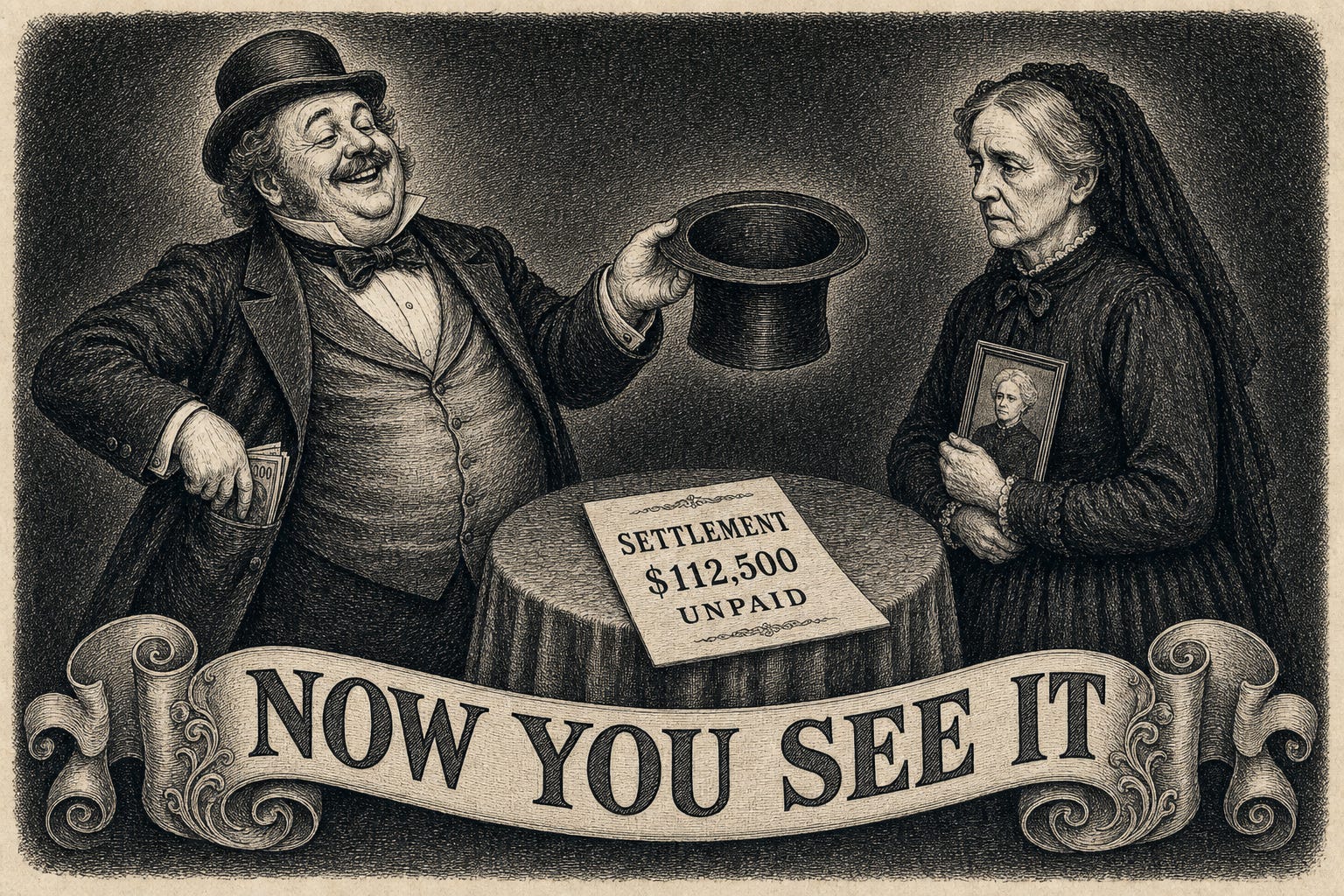
Margarett was placed on a ventilator. She died three months later, at 76, from ventilator-associated pneumonia. The family sued the company that ran the home, Genesis Healthcare, and in October 2024 the two sides agreed on a figure: $950,000. Genesis paid most of it. It never paid the final installment of $112,500.
“We never found out the truth,” Harley said. “If you settle out of court, you know doggone well you did something wrong.” (KFF Health News)
That missing $112,500 is not a story about one company being cheap. It is a pattern.
The number behind the number
KFF Health News reviewed 155 settlement agreements Genesis had signed with families. The company had paid nothing in 85 of them and paid only partially in 70 more. Of the $58 million it had promised, it still owed $41 million. Across nearly a thousand settled and pending cases, its estimated liability was roughly $259 million (KFF Health News).
These are not disputed claims. A settlement is the moment a company stops arguing. Every one of those families had already been through years of litigation, arbitration fights, and depositions — and had reached the point where the company signed a piece of paper agreeing to pay.
Then, in July 2025, Genesis Healthcare filed for Chapter 11 (Healthcare Dive).
Nellie Betancourt, a retired nurse in Albuquerque, fractured her hip at a Genesis facility; the medical examiner linked the injury to her death. Her family settled for $650,000, paid in seven installments, with the first not due for a year.
“It just feels like they killed my mom and got away with it,” said her daughter, Vanessa Betancourt.
Her husband Gabe put it more precisely: “They can file for bankruptcy again. We’re the ones who will pay for it, with our memories, our lives.”
Alma Brown taught accordion and managed a daycare before entering a Genesis home in Clovis, New Mexico. She died in 2023 after falls, infections, and bedsores. Her family settled for $3 million. Two million remained unpaid. A Santa Fe district judge, Kathleen McGarry Ellenwood, announced she would impose more than $100,000 in fines plus $10,000 per day until Genesis paid.
Genesis filed for bankruptcy the same day.
“Genesis obviously benefited by not having to go to trial,” the judge said. “They assure me that they’re not trying to renege on their contract, but it certainly seems like they haven’t lived up to what the bargain was.” (KFF Health News)
The word that does the work
Genesis entered bankruptcy with approximately $708 million in secured debt and more than $1.5 billion in unsecured debt (Healthcare Dive).
Secured means a lender has the right to seize an asset if the debt goes unpaid — a building, a receivable, a piece of equipment. Unsecured means you are owed money and have nothing available to seize.
Margarett Johnson’s family is in the second category. So is Alma Brown’s. So are all the families in those 155 agreements. In a bankruptcy court’s priority scheme, the people whose mothers died are legally junior to the institutions that lent the company money to buy the buildings where their mothers died.
That is not a scandal. That is the law working exactly as written, which is the point.
Nobody chose to put grieving families behind secured lenders. It simply happens when the harm a company does to people is converted into an unsecured claim, and the money a company borrows from institutions is converted into a secured claim. The structure sorts them without anyone having to decide.
The part that is a scandal
Genesis’s controlling investor, Joel Landau, moved to buy the company out of its own bankruptcy — while securing liability releases for himself and an associate, David Gefner.
Bankruptcy Judge Stacey G.C. Jernigan refused to approve any sale that included those releases, noting that Landau had declined to appear or respond to a subpoena (KFF Health News).
What? A company harms people. It settles with them. It does not pay. It enters bankruptcy, which suspends the courts’ ability to compel it to pay. And then the man who controlled it proposes to buy the same company back, cleansed of its obligations to those people, without even showing up in person? Indeed, that is the case.
Senators Elizabeth Warren, Richard Blumenthal, and Representative Maggie Goodlander, filed an amicus brief urging the court to appoint an independent examiner to review how the bidding was run and how insiders were treated (Warren). After the ruling, Warren said: “A private equity company tried to abuse the bankruptcy system to slither out of paying what they owe to neglected seniors in its nursing homes. This is a textbook case of why we need to get private equity out of health care altogether.” (KFF Health News)
Erin Pearson’s father, James Sanderson, a retired mining executive, died in 2018 after less than a month at an Albuquerque Genesis facility. During that month he experienced repeated falls, medication errors, and a bowel obstruction that went eight days from the first sign of trouble to hospitalization. Genesis appealed to arbitration; the case took two and a half years to resolve. The settlement was $500,000. Nothing was paid.
“I don’t know if I’ll ever see that settlement,” Pearson said, “but I would like to be hopeful.”
Why this is not a story about bad people
It would be easier if it were.
The instinct, upon reading the above, is to look for the person responsible — the administrator, the owner, or the investor who would not answer a subpoena.
But consider how the outcomes might have been different if Genesis had been structured differently?
Genesis was taken private in 2007 through a $1.7 billion leveraged buyout by Formation Capital and JER Partners. In 2011, it sold 147 of its properties to a real estate investment trust for $2.4 billion, converting buildings it had owned into buildings it had to rent forever, at a price that rose every year. The cash from that sale went to investors immediately. The rent obligation stayed.
By 2025, the company owed more than $2.2 billion, and the eighteen-year-old decision to sell the real estate meant there was no real estate left to sell.
There was nothing available to pay Angelina Harley’s family with. The last dollar had been converted into a distribution in 2011, to people who no longer had anything to do with the company, before her mother ever entered the building.
The Enron Resolution with California
Here is the part that should unsettle anyone who watched the film and felt that justice, eventually, arrived.
In July 2005, Enron settled with California, Oregon, Washington, and the three big California utilities. The headline number was $1.52 billion. It was reported that way everywhere.
Read the structure. About $47.4 million of it was cash. $875 million was an allowed unsecured claim in Enron’s bankruptcy. $600 million was a civil penalty (FERC, November 15, 2005).
California Attorney General Bill Lockyer said the unsecured claims were then trading at twenty-two to twenty-five cents on the dollar. An Enron spokeswoman said that “a penalty claim is one of the last to be paid under bankruptcy law, and may not be paid” (NBC News). State officials estimated that California would recover between $246 million and $267 million — against a refund claim the state had originally put near $9 billion (Consumer Watchdog, reprinting the Sacramento Bee).
Doug Heller, then with the Foundation for Taxpayer and Consumer Rights, said: “It’s justice in name. I don’t think California ratepayers will actually feel much financial relief from the settlement.”
Lockyer was blunter. “I would have liked to have gotten more. But the reality is that Enron imploded under the weight of its greed and corruption. So there is only so much you can squeeze out of this corporate turnip.”
Now place the two side by side.
The State of California, with an attorney general, a legislature, a federal regulator, and the full attention of the national press, ended up holding an unsecured claim against a bankrupt company and collecting a fraction of a number that had been announced as a victory.
Angelina Harley is holding the same instrument. So is Alma Brown’s family. So is every one of the 155.
The settlement figure is a press release. The recovery is a bankruptcy distribution. Those are two different numbers, and only one of them is real.
Which raises the question the next essay has to answer: if that is how it ends, what has to be true at the beginning for it to end that way every time?
Next: “Mark to Market.” Jeff Skilling would not take the job unless he could change the accounting. What he changed was the timing — booking tomorrow’s estimated profits as today’s earnings on contracts with no market price. A private equity fund does something structurally similar to a nursing home, on a ten-year clock written into a contract before the first facility is bought.
Rick Beeman writes for the Ars Moriendi Project, a 501(c)(3) nonprofit. Freedom from exploitation is the foundational right of every human being. Care, Not Profit.
It's not a story about bad people. It's about bad structures. Once you see the pattern, you can't unsee it.
I'm looking forward to the next one.