
Worthless Services
On Soylent Green, the False Claims Act, and what happens when the contents do not match the label.

Article 3 of 12
Soylent Green (1973) offers a dystopian view of New York City. Set in 2022, the city now holds forty million people. The air is fetid, and the temperature never drops. Water is rationed. Real food — meat, fruit, and vegetables — is contraband, locked away in executives’ apartments. Everyone else eats food provided by a single company, the Soylent Corporation: rationed wafers dispensed from armored trucks.
The Soylent Corporation sells three wafers. Soylent Red and Soylent Yellow are the everyday rations, made from soy and lentils. Soylent Green, however, is different, especially nutritious and flavorful. Advertised as high-energy plankton harvested from the world’s oceans, it is distributed only on Tuesdays and is always in high demand. When the supply runs short, riots are routine. Yellow front-loader “scoops” pick up members of the rioting crowd indiscriminately, dumping them into the trucks like garbage.
The movie offers commentary on the wealth gap and the resulting commodification of people. The rich are insulated, protected, and corrupt, making their fortunes on the suffering of the hoi polloi, the common person. In this world, scholars and researchers are “books,” and attractive women become “furniture” that accompanies the apartment when it is transferred to a new owner.
Detective Thorn (played by Charlton Heston) is called in to quietly investigate the murder of a Soylent Corporation board member. A witness suggests the murder was a hit and that the board member was believed to be a potential whistle-blower.
A “book,” Sol Roth, lives with Thorn. Roth is an elderly former professor who reads what Thorn does not have time for. Sol is able to pull the oceanographic surveys from the corporation’s suppressed reports on Soylent Green: the ocean is no longer producing the plankton from which Soylent Green is ostensibly made. The plankton is gone. Has been gone. And still the green wafers keep coming, on schedule, every Tuesday, from a supply chain that is no longer sourced from the ocean.
When Sol finally figures out the truth, he decides he has seen enough. He decides it is time to go “home” without revealing his findings to Thorn.
He walks to the state euthanasia center and gives them his name. Then he places his order, specifying the conditions he wants to experience as his euthanasia proceeds: to hear Beethoven and to watch films of the fields and rivers of a world he last saw as a young man. He dies watching a film from a planet that no longer exists.
Thorn witnesses the process. He then follows the body out of the center, where it is loaded onto a garbage truck, taken to a site, and thrown onto a conveyor belt that carries the dead into the Soylent Green processing plant.
It is the reveal at the end of the movie that makes it memorable. “Soylent Green is people!” shouts Thorn as he is being carried away by the police.
That is the fraud Soylent Green is actually about. Not the horror at the end, but the ongoing lies created by corporate elites to keep a people subdued.
Selling the lobby
Norma Pecora’s five-star nursing home had a lobby. It also had air conditioning, though the air conditioning did not follow her to the room she was eventually moved to.
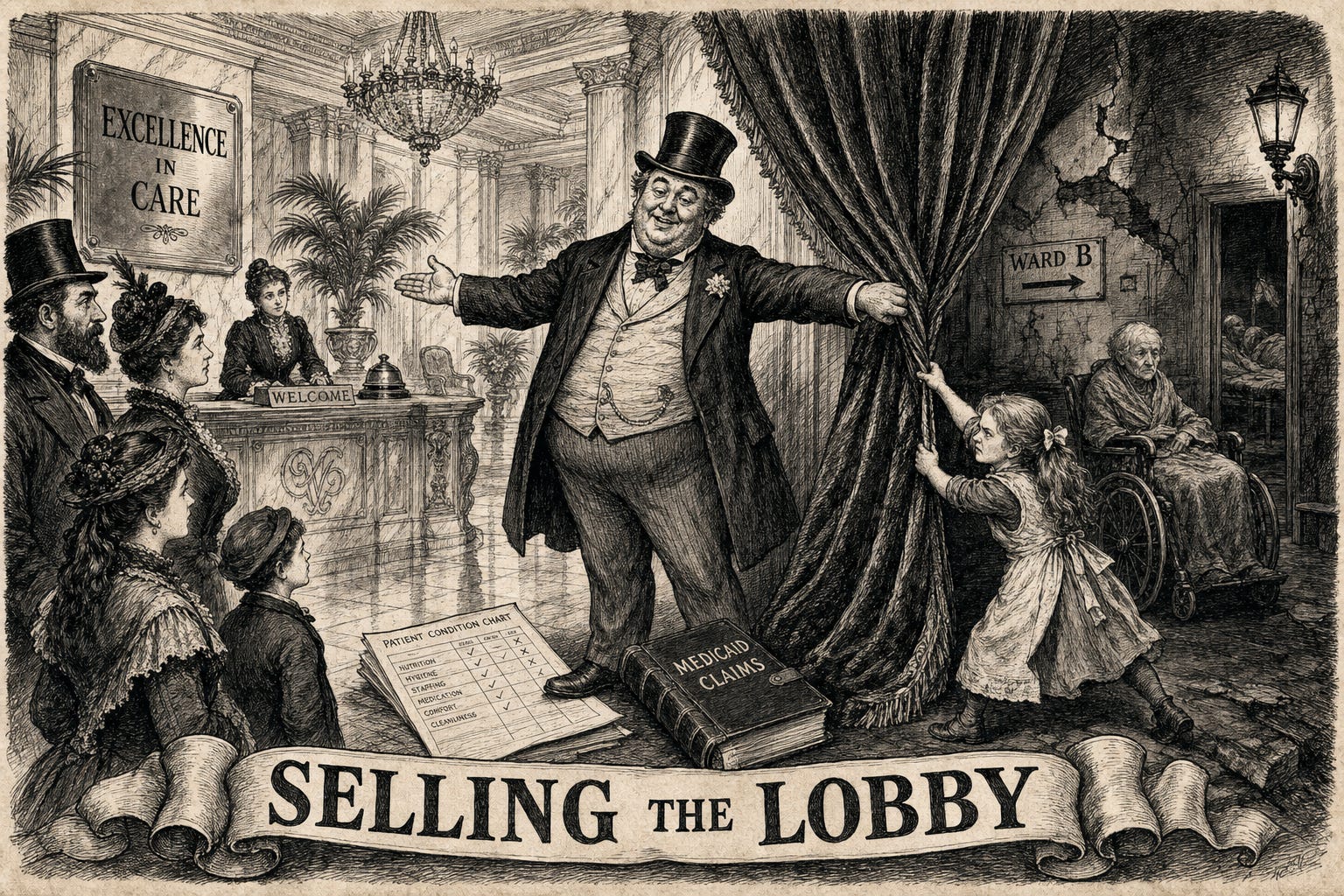
In No Country for Old People, a reporter interviewed by Susie Singer Carter describes the industry practice with a phrase that sticks in the ear. He calls it “selling the lobby.” The lobby is what the family sees on the tour. Clean carpet. Fresh flowers. A piano. Framed accreditations. A receptionist who smiles. The lobby is the part of the facility engineered to be photographed. The lobby is the part that matches the brochure. The lobby is what the five-star rating actually seems to rate.
By all accounts, Norma’s facility was not a low-tier custodial warehouse. It was five-star, well-respected, the kind of place a daughter chooses precisely because the rating, the reputation, and the lobby all align—the Soylent Green of nursing homes. How lucky she felt to have found it.
But beyond Norma’s lobby lay another reality entirely. She was eventually moved to a wing without air conditioning and to a room without it, out of sight of the tour route and out of range of the amenities the rating had promised. The billing label did not change. It still read skilled nursing. The advertising said care. The rating said excellence. The billing to Medicare and Medicaid said, every day, that the bundle of services required by federal law had been delivered.
The condition of the resident, Norma, said something else. Dry mouth. A bridge belonging to another patient. A stage-four pressure ulcer explained away as “skin issues.” A nebulizer treatment refused. Dehydration, urinary tract infection, aspiration pneumonia, sepsis, and ten percent kidney function on the ambulance ride out. A daughter told to stop asking questions. A fentanyl drip and Versed started that kept her subdued without her consent.
Norma’s support didn’t come as it should have from the facility’s staff. It came from family. Susie, at the bedside every day, filmed what the chart refused to record. The institution kept selling the lobby. Care arrived because someone who loved the person cared enough to walk past it, down the hallway, into the hot wing where the tour never went, and to insist on services.
The distance between Soylent Green’s world and the Five Star Facility is smaller than imagined. In both, high-end claims mask a dystopian reality.
There is a remedy available.
Federal law has a specific name for this. The False Claims Act, 31 U.S.C. § 3729, imposes liability on anyone who knowingly presents a false or fraudulent claim for payment to the federal government (Cornell LII). Damages are trebled. Per-claim penalties stack. One of the statute’s most consequential features is that private citizens — relators — can file suit on the government’s behalf and share in the recovery. This provision is called qui tam, and it is the mechanism through which most nursing-home fraud cases have historically reached federal court.
Two doctrines within the FCA carry the weight of what happened to Norma.
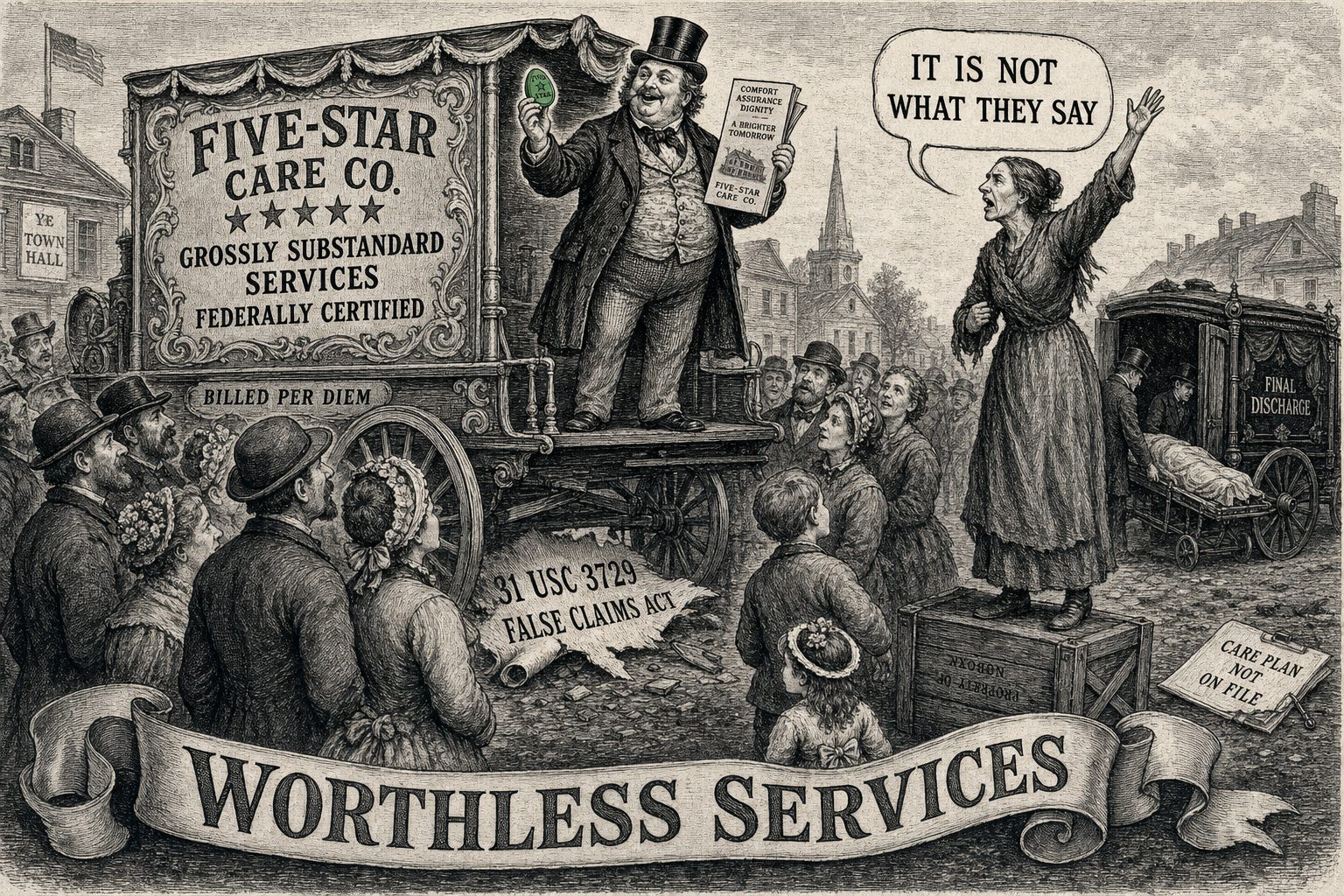
The first is called worthless services. It began in United States ex rel. Mikes v. Straus, 274 F.3d 687 (2d Cir. 2001), which described the theory as a knowing request for federal reimbursement for a procedure that was “of no medical value” (Feldman PLLC overview). The theory holds that a provider who bills for care so deficient that no reasonable person would call it care has submitted a false claim. Not a poorly documented one. Not a low-quality one. A false one. The service the government paid for was not the service delivered.
The second is implied certification. In Universal Health Services, Inc. v. United States ex rel. Escobar, 579 U.S. 176 (2016), a unanimous Supreme Court held that when a provider submits a claim, it implicitly certifies compliance with the statutory, regulatory, and contractual requirements that make billing legitimate (Justia). A skilled nursing facility that bills Medicaid while quietly ignoring the staffing, infection-control, and quality-of-care rules that define skilled nursing is not merely providing bad care. Under Escobar, it is making a false claim every time it invoices.
Alongside the FCA are the Anti-Kickback Statute, 42 U.S.C. § 1320a-7b(b), and the Stark Law, 42 U.S.C. § 1395nn, which criminalize payment and referral arrangements that make substandard care profitable in the first place (HHS-OIG). These statutes reach the related-party web — the real-estate entity that owns the building, the management company that runs it, the pharmacy, the therapy provider, the staffing agency — when money moves among them for reasons other than patient benefit. That web is the subject of the next essay in this series. For this one, the relevant point is that the FCA does not stand alone. It sits atop scaffolding designed to make the label match the product.
The cases, and the case that was not filed
In fiscal year 2024, the Department of Justice reported more than $2.9 billion in False Claims Act settlements and judgments, roughly $1.67 billion of which was tied to the Department of Health and Human Services — the umbrella category that includes Medicare, Medicaid, and every provider type from pharmaceutical companies to hospitals to nursing homes (DOJ statistics via Sidley; Morgan Lewis). Health care is the largest category of federal fraud recovery, year after year. And year after year, the bulk of those dollars comes from pharmaceutical marketing cases, hospital upcoding, medically unnecessary procedures, and kickbacks tied to drug and device sales. Nursing-home cases — cases built on the ordinary contents of a nursing-home room — remain a small sliver.
When those cases are filed, they work. Consider two recent examples.
In June 2025, the American Health Foundation, its management affiliate, and three of its nursing homes agreed to pay $3.61 million to resolve allegations that they billed Medicare and Medicaid for “grossly substandard” skilled nursing services (DOJ press release). According to the DOJ’s own summary, the government’s allegations read like a walkthrough of the daily conditions at the facilities: infection-control protocols were not followed, staffing was not maintained, residents at Cheltenham Nursing & Rehabilitation Center were housed in a dirty, pest-infested building, unnecessary medications were administered, residents were verbally abused, and, at two of the three facilities, no resident care plans or assessments existed at all (DOJ FY2025 settlements list). Every day of that, at every facility, was billed. Every bill implicitly certified compliance with rules that were not being followed.
In parallel, the Justice Department filed a complaint against ProMedica Health System, its affiliate HCR ManorCare, and four ManorCare nursing homes, alleging that the facilities provided “non-existent, grossly substandard” skilled nursing care, including failures in wound care and hygiene (DOJ FY2025 settlements list). ProMedica is not a small operator. At the time of acquisition, HCR ManorCare was one of the largest post-acute chains in the country. The complaint applies the worthless-services theory at portfolio scale.
The doctrine is not the problem. It works when it is used.
Now read those allegations alongside the last essay’s account of Norma’s room. Every day of Norma’s stay generated a Medicare or Medicaid claim identifying her as receiving skilled nursing under a defined federal bundle: assessment, care planning, skilled observation, wound care, hydration and nutrition monitoring, infection control, medication management. Under Escobar, each of those claims implicitly certified compliance with the rules that make skilled-nursing billing lawful.
Now, put the contents of the room next to the label on the claim. The care plan required by regulation, in Norma’s case, either did not reflect the reality of her condition or was not being followed. The infection-control protocols that would have prevented the urinary tract infection, the aspiration pneumonia, and the sepsis were not effectively in place. The turning schedule that would have prevented the stage-four pressure ulcer was not followed. The hydration monitoring that would have prevented the acute kidney injury did not occur with the frequency the standard requires. The medication management at end of life proceeded without the informed consent of the legally recognized surrogate.
Each of those failures is a factual predicate for a false claim. Not in the abstract. In the specific, dated, dollar-denominated sense that FCA complaints require. The chart is not just clinical documentation. It is billing documentation. When the two disagree — when the chart records care that the body in the bed shows was not delivered — the disagreement itself is the case.
What separates Norma’s story from AHF and ProMedica is not the evidence. It is whether anyone filed.
The two doors that could close
The FCA’s power depends on the qui tam provision. Most nursing-home cases begin not with a DOJ investigator but with a relator — a nurse, a former administrator, a coder, or a family member — walking into a whistleblower firm with documents the government would never have gathered on its own. Without that pipeline, the government sees only what state surveyors and Medicare contractors happen to catch, which, at Norma’s facility, was memorably five stars.
That pipeline is now facing constitutional attack. On September 30, 2024, in U.S. ex rel. Zafirov v. Florida Medical Associates, Judge Kathryn Kimball Mizelle of the Middle District of Florida held that the FCA’s qui tam provision violates Article II’s Appointments Clause because it allows a private citizen to exercise core executive authority without presidential appointment (Greenberg Traurig; Latham & Watkins). The Eleventh Circuit heard oral argument on the appeal on December 12, 2025 (Crowell & Moring). A parallel challenge is pending in the Third Circuit (Feldesman). In April 2026, the U.S. Chamber of Commerce filed an amicus brief in Eli Lilly v. Streck, asking the Supreme Court to grant certiorari and take up the constitutional question directly, describing private relators as “profit-driven” abusers of the qui tam device (U.S. Chamber amicus). If any of these courts affirms Zafirov, or if the Supreme Court accepts the invitation, the mechanism that produces most nursing-home fraud cases would narrow sharply. DOJ can still bring cases, but it lacks the informant network to bring them at anything like the necessary scale.
The attack on qui tam is one front in a larger, well-funded campaign against private enforcement of the law on behalf of the government or the public. The Chamber of Commerce has filed amicus briefs against private relators in Polansky, Zafirov, the Third Circuit challenge, and now Streck, arguing across these cases that qui tam is constitutionally illegitimate (U.S. Chamber litigation page).
In California, Uber is spending heavily on a November 2026 ballot initiative that would cap plaintiffs’ attorney fees at 25 percent in vehicle-accident cases, framing plaintiffs’ lawyers as “billboard lawyers” who self-deal at their clients’ expense (Reuters). The Uber measure does not touch the FCA. It targets contingency-fee tort litigation. But the rhetorical playbook is the same one being used against qui tam: recast the private enforcer as a parasite, recast the client as a victim of their own lawyer, and shrink the mechanism through which corporations can be held to public standards without the government initiating the case. If that framing wins broadly, the daughter with the camera does not just lose a federal venue. She loses the cultural permission to walk into a lawyer’s office at all.
The state layer is thinner than it should be. According to the Anti-Fraud Coalition, 33 states and territories have false claims acts with qui tam provisions, though not all cover the full scope of state spending; several are limited to Medicaid fraud, and a handful cover only insurance or tax fraud (Anti-Fraud Coalition). Fourteen states have no state FCA with qui tam provisions at all: Alabama, Alaska, Arizona, Idaho, Kentucky, Maine, North Dakota, Ohio, Pennsylvania, South Carolina, South Dakota, Vermont, West Virginia, and Wyoming (Greene LLP survey). Two of those are actively trying to join the list: Pennsylvania’s House approved a proposed state FCA in July 2025, still pending in the state senate, and Ohio’s legislature has been considering one (Anti-Fraud Coalition). In states without any state FCA, when the federal case is narrowed or foreclosed, there is often no second door. The daughter with the camera has no venue.
The ask
· Congressional reaffirmation of the FCA’s qui tam provisions. The constitutional attack is real. Congress has both the authority and the reason to restate the qui tam mechanism to be consistent with executive-power doctrine, and to do so before the Supreme Court resolves the question in the government’s absence.
· Model state FCA legislation for states without one. Fourteen states — with Pennsylvania’s bill in flight and Ohio’s under consideration — have no state False Claims Act with qui tam authority. A state FCA with qui tam authority and treble damages closes the second door that federal doctrine may narrow and does the practical work of recovering state Medicaid dollars when a facility bills for care it did not provide.
· DOJ prioritization of nursing-home worthless-services and implied-certification cases. American Health Foundation and ProMedica are proofs of concept, not a program. The doctrinal tools exist. The evidence — state survey findings, hospital transfer records, ombudsman complaints, and family documentation — already resides in state and federal files. The remaining variable is prosecutorial attention.
· A counter-narrative to the “billboard lawyers” framing. The Chamber of Commerce and the corporate defense bar are pouring money into a narrative that casts private enforcers of public law as the problem. The counter-narrative is straightforward and true: without private relators, most large-scale fraud against the government goes undetected, and without contingency-fee plaintiffs’ lawyers, most catastrophic-injury victims go unrepresented. In the nursing-home context, the daughter with the camera is not a billboard lawyer. She is the last line of enforcement standing between the label and the room.
The wing beyond the lobby
Norma died in the wing beyond the lobby, out of range of the air conditioning and the rating, in a room the tour did not include and the brochure did not photograph. By the time she reached that room, the facility had stopped pretending to her. But the billing was still pretending to the federal government.
The False Claims Act, at its core, is a truth-in-billing statute. It holds the seller accountable for whether the specific thing the government paid for was the specific thing delivered. Applied to nursing homes, it is one of the few instruments in federal law that can force the front of the house to answer for the back of it — the wing where the tour does not go, the room where the air conditioning stops, the bed where the label and the body no longer agree.
Susie walked into that wing and filmed the gap. The doctrine already exists. The claims have already been paid. What is missing is the room where someone says: file.
Where this series goes next
Soylent Green names the doctrine. Enron follows the money. The next essay examines the ownership webs, related-party contracts, and financial disclosures that turn a nursing home from a care setting into an extraction platform, and asks how securities and fraud law can bring those structures into view. Life and Death in Assisted Living then examines what happens when a state — New York — writes a profit cap directly into statute and defends it against industry challenge.
The parable of Soylent Green is that the delivery system kept working on schedule long after the product no longer matched the label, and the citizens kept lining up on Tuesdays because the lobby of the transaction still looked right. The rest of this series is about how to make the label mean something again and how to make the people who sold the lobby answer for the wing behind it
.
Rick Beeman is the founder and executive director of the Ars Moriendi Project, a 501(c)(3) nonprofit organization. He is the author of Bought for Parts: How Wall Street Is Profiteering on Your Mother’s Pain and Understanding Nursing Home Extraction: A Plain-English Guide and Glossary to How For-Profit Owners Turn Care into Cash. He has served as a chaplain in retirement homes and elder care settings for more than forty years.
Everyday Elders is the publication of the Ars Moriendi Project. Our mission is to achieve freedom from exploitation. Our operating principle is care, not profit.
Subscribe to receive each of the ten doctrinal essays as they are published, plus the closing article featuring the Reform Roadmap. Every essay is free to every subscriber. A paid subscription is a tax-deductible donation to the Ars Moriendi Project, supporting the ongoing work of elder advocacy — including the podcast interview series with experts, advocates, and filmmakers working on and reporting about elder care accountability, which will begin releasing later this year.